
Women’s Health Consultation
Our Women’s Health Physiotherapy consultations focus on understanding your body, your symptoms, and your goals, providing a personalised, evidence-based management for all stages of life.
Whether you’re navigating pregnancy, recovering post-partum, managing pelvic symptoms or looking to improve pelvic and core function, these consults are designed to help you feel confident and informed to get you back doing what you enjoy.
Conditions Treated
Women’s Health Physiotherapy can help with:
Pre-natal pelvic floor muscle training and birth-prep
Post-partum recovery and return to exercise
Urinary leakage
Pregnancy-related pain and discomfort
Pelvic girdle pain
Pelvic floor symptoms impacting sport or daily activities
What A Women’s Health Consult Looks Like
Your initial Women’s Health consult begins with a detailed conversation about your medical history, current symptoms and goals.
From there, we will recommend the most appropriate assessments to gain a clear understanding of how your pelvic floor and core are functioning.
Assessment options may include:
External examination - Assessment of posture, breathing, movement, and external pelvic floor and abdominal muscles.
Transabdominal ultrasound - A non-invasive ultrasound used on the lower abdomen to assess pelvic floor tone and activation in real time. More information about Real-Time Ultrasound can be found here.
Internal examination - An internal pelvic floor assessment to evaluate muscle strength, coordination and control. This is always optional and only performed with your informed consent.
You’re in control throughout the session. Everything is explained clearly, and assessments are only performed if appropriate for you. Following the assessment, we will discuss findings with you and outline a clear management plan, including education, exercises and practical strategies to manage your symptoms and support your goals.
Pelvic Floor Anatomy
The pelvic floor is a group of muscles and connective tissues that sit at the base of the pelvis, forming a supportive sling between the pubic bone at the front and the tailbone at the back.
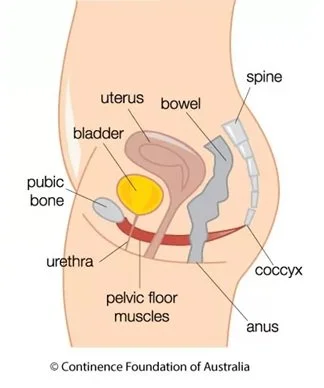
These muscles support the bladder, bowel and the uterus, and play an important role in bladder and bowel control, core stability, posture and sexual function.
For the pelvic floor to function well, it needs to be strong, coordinated and able to both contract and fully relax. Changes such as pregnancy, childbirth, surgery, high-impact exercise, pain or prolonged stress can affect how these muscles work, which may lead to symptoms.
Women’s Health Physiotherapy focuses on assessing and retraining the pelvic floor as part of the whole system, helping restore optimal function and confidence in everyday movement.
Stress Urinary Incontinence in Female Athletes
Urinary incontinence is often assumed to affect only women in the post-partum period or during menopause. However, it is also common among female athletes, particularly when the pelvic floor is unable to withstand the increased physical demands of their sport. Evidence suggests that stress urinary incontinence may affect up to 36% of female athletes (Teixeira et al., 2018).
Stress incontinence refers to involuntary urine leakage during activities that increase pressure through the abdomen, such as running, jumping, coughing or lifting. In female athletes, this can have a significant impact on both performance and wellbeing.
Physical and Psychological Impact:
Leakage during high-impact or explosive movements (e.g. sprinting, jumping, landing)
Difficulty maintaining pelvic floor control under fatigue
Avoidance of certain drills, exercises or competitions
Reduced confidence during training and game situations
Hesitation to push intensity or load
Embarrassment or fear of visible leakage
Increased anxiety around training and competition
Withdrawal from team environments or sport altogether
Stress incontinence is common in sport but not normal, and it is highly treatable. Women’s Health Physiotherapy can help young female athletes improve pelvic floor function, confidence and performance, without needing to stop doing the sport they love.
Bookings for Women’s Health appointments can be made online or calling the clinic. If you would like further information about out Women’s Health services please contact the clinic.
Meet Kate
Kate is The Physio Lab’s Womens Health Physiotherapist, with a strong passion for Pelvic and Women’s Health care. She holds accreditation in the Australian Physiotherapy Association’s Level 2 Pelvic Health. Kate has also received direct mentorship from other specialists in the Women’s Health space, enriching her evidence-based approach to care. She is committed to helping her patients feel confident, supported, and empowered through personalised, compassionate treatment.
